 16 July 2026
How to Plan a Downtown Toronto Notary Public Visit
Plan a Toronto notary visit by confirming the recipient’s requirements, document type, identification, signing method and any apostille steps first.

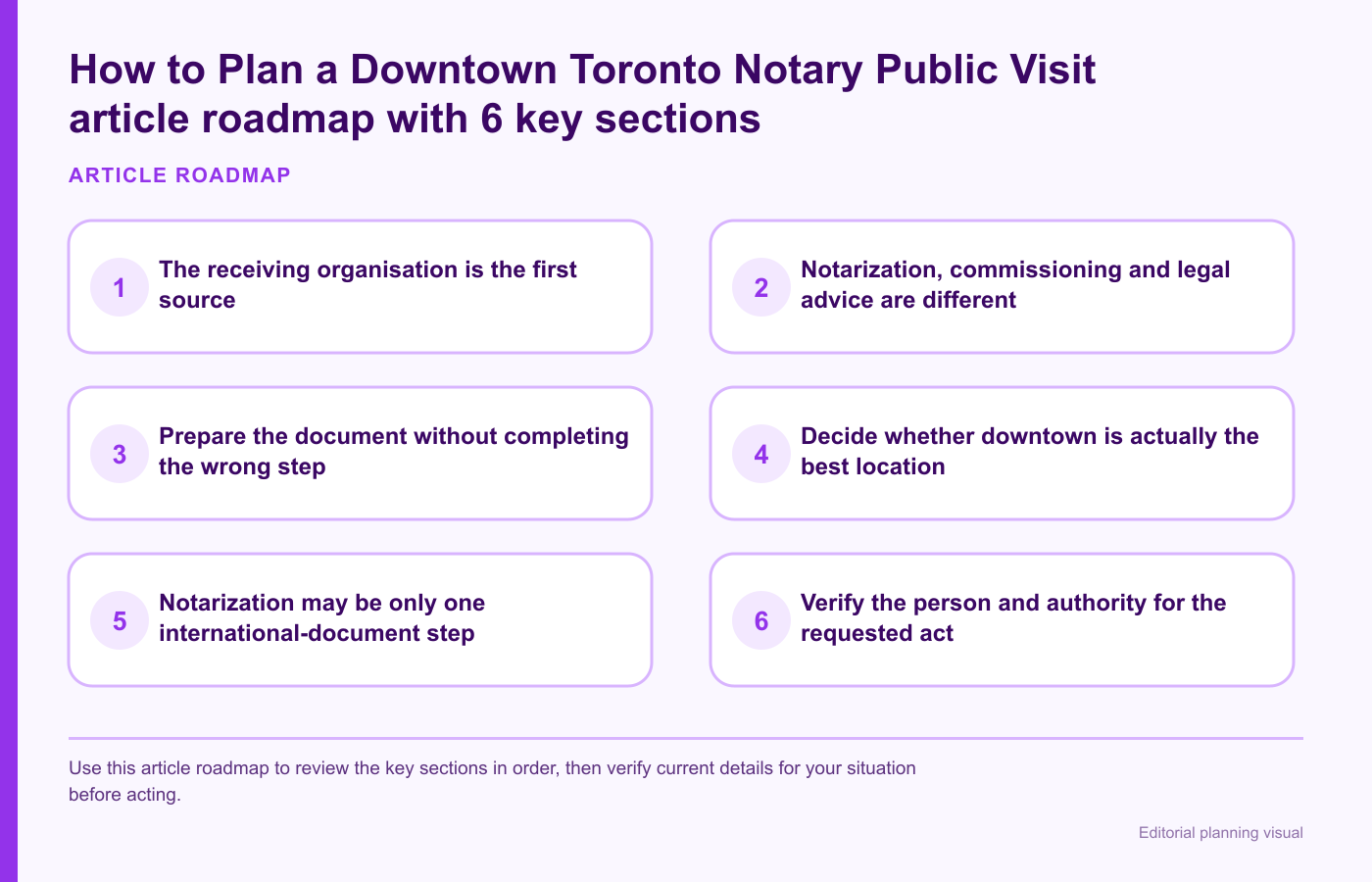
The receiving organisation is the first source
A notary cannot guarantee that a court, school, bank, consulate, foreign authority or private company will accept a document. Ask the recipient for current written instructions. If a web page is unclear, request an email that states what must be witnessed, certified or sworn and whether an original, copy, translation or additional authentication is required.
Record the recipient’s full name and country or jurisdiction, the document name, deadline, required wording, number of originals or copies, signature and witness rules, ID requirements, and what must happen after notarization. Bring those instructions to the appointment. Do not substitute a blog’s general description for recipient-specific rules.
If the document asks for legal advice, drafting, independent legal advice, capacity assessment or a legal opinion, say so when booking. Those tasks are not automatically included in a routine witnessing or copy-certification appointment. The professional must confirm whether the matter can be handled and under what engagement.
Notarization, commissioning and legal advice are different
Ontario’s page on finding a notary or commissioner explains that commissioners take affidavits or declarations by administering an oath or affirmation. It says a notary public has those powers and can also verify whether signatures, marks and copies are true or genuine.
| Recipient wording | Possible act to confirm | Question before booking |
|---|---|---|
| “Certified true copy” | Comparison of a copy with an original by an authorised person | Must the original be presented, and are copies supplied or made at the appointment? |
| “Witnessed signature” | Identity and signing witnessed in the authorised person’s presence | Must the document remain unsigned until the appointment, and are extra witnesses required? |
| “Sworn affidavit” | Oath or affirmation attached to a written statement | Is the document complete, and does the recipient require a particular form or venue? |
| “Statutory declaration” | Formal declaration administered by an authorised person | Which prescribed wording and jurisdiction apply? |
| “Notarized translation” | Could involve translator credentials, an affidavit or notarial attestation | Who may translate, and what exactly must the recipient receive? |
| “Apostille” | Government authentication process after eligible document preparation | Is notarization required first, and which authority handles the document? |
This table is orientation, not a determination for a specific document. Send the exact recipient wording when asking for service. Do not alter prescribed text or attach a homemade notarial block without confirmation.
Prepare the document without completing the wrong step
- Keep the signing section unsigned. If the signature must be witnessed, signing early may make the document unusable for that process.
- Complete factual blanks you are responsible for. Do not leave material facts for the notary to guess, but do not fill a jurat, seal or professional certification section yourself.
- Bring the required original identification. Confirm acceptable type, validity, name matching and the number of pieces required.
- Bring original documents when certifying copies. Ask whether the office makes copies or expects them prepared.
- Resolve name differences. If the document and ID use different names, ask the recipient and service provider what supporting evidence is needed.
- Arrange required witnesses. A notary does not automatically supply every witness, and some documents restrict who may witness.
- Explain language needs. The professional must be satisfied with the process; translation or interpretation rules may apply.
- Count final sets. Confirm whether the recipient needs multiple separately signed or sealed originals.
Decide whether downtown is actually the best location
Someone searching “downtown Toronto notary public” may be optimising for a workday appointment, transit access, proximity to a consulate or the Ontario Official Documents Services office, or a same-trip filing. Write that logistical goal down. The nearest notary may not be the best fit if the document requires a different service, language, witness arrangement, remote process or follow-on location.
Vikram Sharma Law Professional Corporation’s current site lists its office at 23 Westmore Drive, Unit 218A, Toronto, Ontario M9V 3Y7. That is not a downtown Toronto address. The website also has a notary public services page, but online wording should not be treated as confirmation that a specific document can be handled, that a walk-in is available or that a quoted price applies.
Before travelling to any provider, confirm the exact address and unit, appointment or walk-in policy, accessibility, parking or transit plan, documents, IDs, witnesses, language needs, fee, payment method and expected output. If you are combining notarization with a downtown authentication visit, verify both offices’ current requirements and hours independently.
Notarization may be only one international-document step
Ontario’s current guide to authenticating a document for use outside Canada says to verify requirements with the relevant consulate, embassy or end recipient first. Depending on the document and destination, an Ontario document may qualify for direct authentication, require prior notarization, need translation, receive an apostille for a Hague Convention destination or follow another pathway.
Canada joined the Hague Apostille Convention in 2024, but “apostille” is not a synonym for notarization. In Ontario, Official Documents Services handles eligible Ontario documents and checks signatures and seals against its records. Some documents do not need notarization before that step, while foreign-issued documents have different eligibility. Use the provincial portal and current guidance for the exact document.
For documents not in English or French, translation rules can be precise. The Ontario page describes certified-translation and, in certain circumstances, notarial-attestation pathways. Do not ask a notary to “just stamp” a translation unless the recipient and authentication authority accept the proposed method and the professional can lawfully provide it.
| International file question | Who should answer |
|---|---|
| What form and wording are accepted? | End recipient, consulate or embassy |
| Does the original require notarization? | Recipient plus Ontario authentication guidance |
| Who may translate? | Recipient and applicable authentication rules |
| Is an apostille or authentication certificate required? | Destination requirements and Official Documents Services |
| Can the document be mailed or submitted in person? | Current Official Documents Services instructions |
Verify the person and authority for the requested act
A business name or professional-looking website is not enough. The Law Society of Ontario recommends using its Lawyer and Paralegal Directory to confirm a legal professional’s current licence information. Where a notary’s authority comes from another appointment process, ask how current authority for the requested act can be confirmed.
Authority can be limited by status, appointment or jurisdiction. Confirm the full name of the person who will act, the capacity in which they will act, and whether the recipient accepts that capacity. This article does not verify Vikram Sharma’s current licence, notarial appointment, standing or authority for a particular document.
If a document needs independent legal advice, the adviser may need to be independent from another party and complete more than witnessing. If it concerns a foreign jurisdiction, the Ontario provider may not be able to advise on foreign law. State the real requirement rather than booking the cheapest item labelled “notary.”
A confirmation message that prevents a wasted visit
Send a privacy-conscious description rather than sensitive documents through an unverified channel:
- document name and issuing jurisdiction;
- receiving organisation and destination country;
- exact instruction: witnessed signature, certified copy, affidavit, declaration or other act;
- whether the document is signed already;
- number of signers, copies and required witnesses;
- language and translation status;
- deadline and any later apostille or authentication step;
- identification available and any name difference;
- accessibility or interpretation needs;
- request for address, appointment, fee and output confirmation.
Ask the office to reply with what it can and cannot confirm before the appointment. A provider may need to inspect the full document before accepting the work. Use an approved secure method if the office requests document review; do not email identity documents casually.
Notary visit mistakes and red flags to avoid
- Signing before the appointment. A witnessed-signature process may require signing in front of the authorised person.
- Asking the notary to choose the recipient’s requirements. Get written instructions from the recipient first.
- Confusing a commissioner with a notary. Ontario describes overlapping but not identical powers.
- Assuming notarization guarantees foreign acceptance. Translation, apostille, authentication or legalisation may still be required.
- Booking by map distance alone. Confirm service fit, actual address and follow-on steps.
- Assuming Vikram Law is downtown. Its current site lists Westmore Drive, not a downtown office.
- Relying on a website licence claim. Check the current official directory or appointment evidence.
- Sending sensitive documents before verifying the channel. Ask how the office securely receives them.
A document-readiness checklist
| Gate | Ready when |
|---|---|
| Recipient | You have current written instructions and destination details |
| Document | The correct version is complete but unsigned where witnessing is required |
| People | Signers, witnesses, interpretation and capacity questions are confirmed |
| Identity | Accepted original ID and name evidence are ready |
| Provider | Authority, service fit, address, appointment and fee are confirmed |
| Afterward | Copies, delivery, translation and apostille or authentication steps are mapped |
Frequently asked questions
Is Vikram Sharma Law in downtown Toronto?
No downtown location is established by the current site. It lists 23 Westmore Drive, Unit 218A, Toronto, Ontario M9V 3Y7. Confirm the address before travel.
Should I sign my document before seeing a notary?
Not when the signature must be witnessed. Ask first and keep the signing section unsigned until instructed.
Does every international document need an apostille?
No. Requirements depend on document, issuing jurisdiction, destination and recipient. Use Ontario’s current authentication guidance.
Can a notary give legal advice about my document?
Notarization and legal advice are separate services. Explain the actual need and ask whether a suitable legal engagement is available.
Next step with Vikram Sharma Law
Review the firm’s current notary page, then use the contact route to describe the recipient, document, requested act, signers, language and later authentication steps. Ask for written confirmation of service fit, the Westmore Drive location, appointment policy, required ID, witnesses, fee and secure document-review method before travelling.
Legal information note: This article provides general Ontario planning information, not legal advice, licence verification or a promise that any authority will accept a document. Requirements change and must be confirmed for the specific file.