
 14 July 2026
Toronto notary buyer guide
How to Choose a Downtown Toronto Notary Public
Short answer: ask the receiving organization what act it requires, then choose a provider whose current authority, appointment location and process match that instruction. Confirm whether you need a notary public or commissioner, whether originals and witnesses are required, which identity documents are accepted, when to sign, how many copies are needed, the complete fee and whether a document for use abroad needs an apostille or authentication.

Start with the receiving organization’s instructions
The most important question is not “Where is the nearest notary?” It is “What will the recipient accept?” A court, school, employer, regulator, bank, government office, embassy or foreign organization may require a particular form, wording, type of witness, original document, certified copy, translation, seal, apostille or authentication.
Ask the recipient in writing if possible:
- What exact document or form is required?
- Does it need notarization, commissioning, witnessing, certification of a true copy or legal advice?
- Must an original be presented?
- Who must sign, and must signing occur before the provider?
- Are independent witnesses, photographs or special identification required?
- Will an electronic or remote act be accepted, if available and legally permitted?
- How many originals or certified copies are needed?
- Does the document need translation, apostille, authentication or consular steps?
- Is there a deadline or a required validity period?
Do not rely on a sample found online when the recipient has its own current form. The notary’s role in witnessing or certifying an act does not automatically confirm the document’s legal effect, completeness or acceptance.
Know when a notary and commissioner differ
Ontario’s page on how to find a notary public or commissioner explains that commissioners take affidavits or declarations by administering an oath or affirmation. It says a notary public has commissioner powers and can also verify that signatures, marks and document copies are true or genuine.
The current Ontario Notaries Act sets out powers that include witnessing or certifying and attesting the execution of a document, certifying and attesting a true copy, and exercising commissioner powers, subject to the Act and any applicable restrictions. These legal powers do not mean every provider can or will handle every document.
| Requested act | Question to ask | What it does not prove |
|---|---|---|
| Oath or affirmation | Is a commissioner acceptable, or does the recipient require a notary? | That the statement is factually correct |
| Witnessing a signature | Who must be present, and what signing and ID process applies? | That the document is legally suitable or enforceable |
| Certified true copy | Must the original be presented, and what copy format is required? | That the original’s contents are valid or current |
| Legal advice or drafting | Does the person need a licensed legal professional with the relevant scope? | That a basic notarization appointment includes advice |
Check professional status rather than relying only on a website. The Law Society of Ontario directory lists practising status and business contact information for lawyers and paralegals. A separate appointment or authority check may still be needed for the requested notarial act.
Verify the Toronto appointment location before travelling
“Downtown Toronto” is a search phrase, not a verified address. Ask for the street address, unit, appointment format and arrival instructions. Confirm whether the meeting is at the provider’s office, another location or remote where permitted and accepted. Do not assume a provider travels downtown because its website serves Toronto.
Vikram Sharma Law Professional Corporation publishes a Toronto notary page and a separate notarization page. The homepage currently lists 23 Westmore Dr., Unit 218A, Toronto. Before booking, confirm whether the requested act is offered, where the appointment will occur and whether the location works for the recipient’s timing and in-person requirements.
Ask about building entry, accessibility, visitor instructions, transit or parking only after the address is confirmed. If several signers or witnesses are involved, make sure everyone can attend in the required way. If a deadline depends on courier, filing or apostille steps, map those separately from the notarization appointment.
A convenient location cannot cure a mismatch in authority or recipient requirements. Choose fit first, then compare travel and scheduling.
Confirm documents, identity, signing and fees
Send a non-confidential description of the request before the appointment and ask what may be safely shared in advance. Do not email sensitive identification or unredacted records unless the provider has supplied an approved secure process.
Request a written checklist covering:
- The complete document and all pages, schedules and attachments.
- Originals required for a true-copy certification.
- Accepted identity types, number of IDs and name-matching rules.
- Whether the document must remain unsigned until the appointment.
- Whether every signer must attend and whether witnesses are supplied or brought.
- Whether a translation or interpreter is required and who is acceptable.
- The number and format of notarized originals or certified copies.
- The exact act the provider will perform and what is outside scope.
- The full fee, taxes, copy charges, additional signatures, travel or other costs.
- Payment method, receipt and cancellation or rescheduling terms.
- What the completed package will contain and when it will be ready.
Names should be consistent across the form and identity documents. If there is a difference, do not alter a legal document without advice; ask the recipient and appropriate professional what evidence or correction is required.
Never ask a notary to certify a copy when the original cannot be produced if the provider requires the original. Never backdate, leave essential blanks or ask a witness to attest something they did not observe.
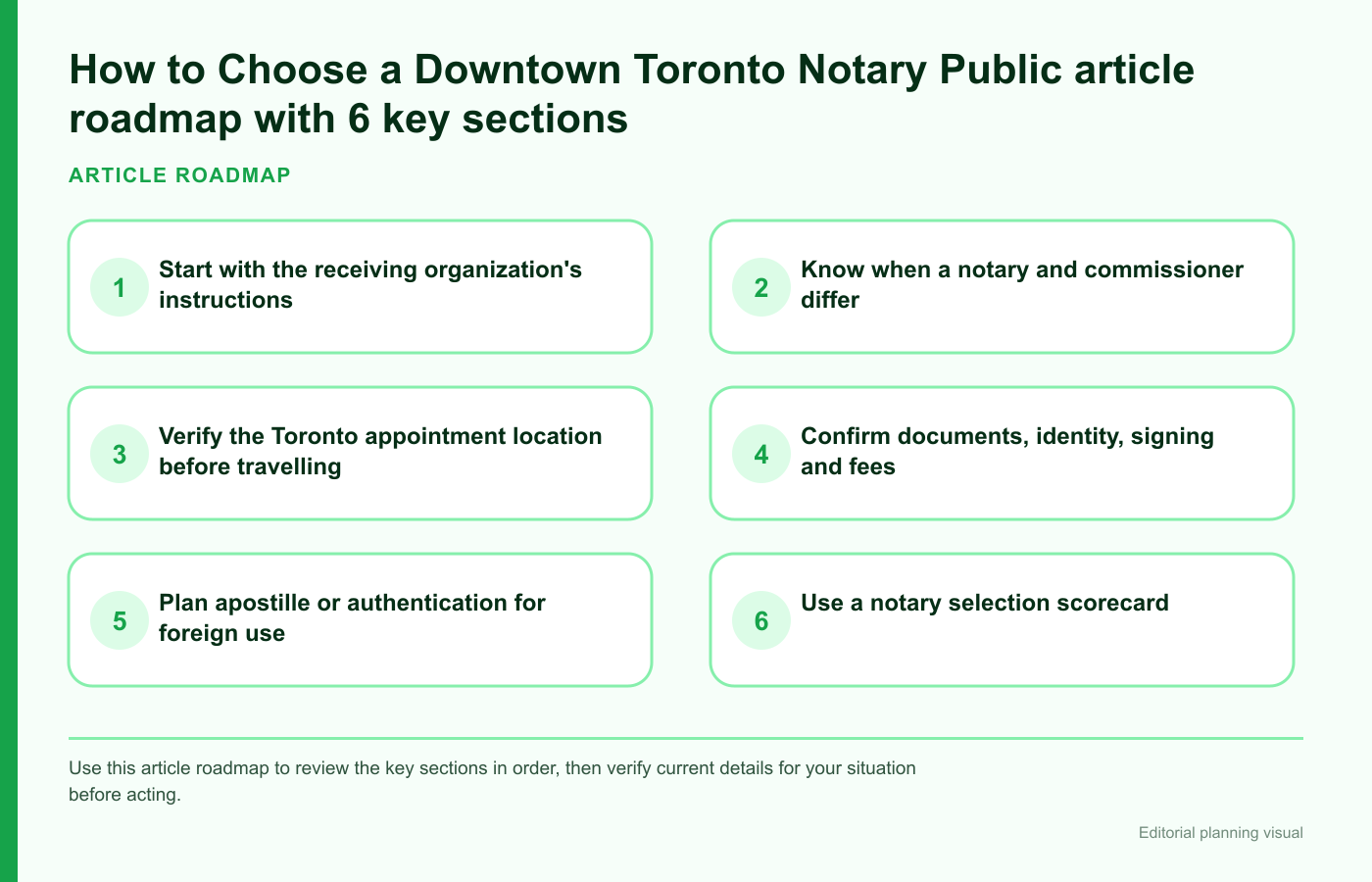
Plan apostille or authentication for foreign use
Notarization and document authentication are different steps. A document intended for another country may need no authentication, an apostille, a certificate of authentication or additional destination-specific steps. The answer depends on the document, issuing jurisdiction, destination and recipient.
Ontario’s current guide to authenticate a document for use outside Canada says Official Documents Services issues authentications and apostilles in Ontario. It tells clients to contact the end recipient, consulate or embassy first. It also explains that some Ontario documents may be eligible for direct authentication and may not require prior notarization.
That means “notarize everything first” can waste time or create the wrong package. Use the Ontario document-authentication portal or current official guidance for the exact document. Documents issued outside Canada can follow the issuing jurisdiction’s process, subject to limited exceptions described by Ontario for signatures witnessed by an Ontario notary.
Translation rules also vary. Confirm whether the destination needs a certified translation, notarized translation, translator’s affidavit or another format. Do not assume the notary also acts as translator or can certify language accuracy.
Use a notary selection scorecard
Give each provider a pass, conditional pass or fail on the same evidence:
- Recipient fit: the provider understands the requested act without rewriting the recipient’s requirement.
- Authority: current status and any relevant appointment or restriction are verified.
- Scope: notarization, commissioning, copy certification and legal advice are clearly separated.
- Location: the actual Toronto appointment address or format is confirmed.
- Documents: originals, pages, copies, identity, witnesses and signing instructions are written.
- Language: translation or interpreter needs and acceptance are resolved.
- Foreign use: apostille, authentication or consular responsibilities are assigned.
- Commercial terms: full fee, taxes, extras, payment and cancellation are clear.
- Deliverable: number of completed documents, seals or certificates and collection method are defined.
- Privacy: sensitive records are handled through an appropriate process.
A provider should fail the shortlist if their authority, location or deliverable cannot be verified. A conditional item needs written resolution before travel or payment.
Common notary appointment mistakes
- Searching by neighbourhood before asking what the recipient requires.
- Assuming a commissioner and notary are interchangeable for every request.
- Assuming a Toronto service page proves a downtown office.
- Signing before confirming whether the signature must be witnessed.
- Bringing a photocopy when the original is required.
- Leaving pages, schedules or exhibits at home.
- Using identification with a different name without asking how to address it.
- Expecting notarization to provide legal advice or validate content.
- Buying notarization when a public document is eligible for direct authentication.
- Assuming an apostille guarantees the receiving organization will accept the document.
- Sharing sensitive identity by ordinary email without an approved process.
- Booking from an unverified fee, hour or address shown in an old search result.
Frequently asked questions
Is a notary public the same as a commissioner of oaths in Ontario?
No. Ontario explains that a notary has commissioner powers and additional powers such as true-copy certification, while a commissioner administers oaths or affirmations within their authority. Ask the recipient which one is required.
Does Vikram Sharma Law have a downtown Toronto notary office?
The current homepage lists 23 Westmore Dr., Unit 218A, Toronto. This guide does not verify a downtown office or downtown appointment. Contact the firm for the current location and availability.
Should I sign the document before the appointment?
Ask first. If the requested act requires the provider to witness execution, pre-signing can create a problem. Follow the recipient’s form and the provider’s written instructions.
Does a notarized document automatically work outside Canada?
No. It may need an apostille, authentication, translation or destination-specific step, and some public documents may be directly eligible for authentication. Check with the recipient and current Ontario guidance.
Request a recipient-specific notary appointment check
Use the firm’s contact page to request an eligibility and appointment check. Provide the recipient’s written instructions, document type, issuing jurisdiction, destination and deadline without sending unnecessary sensitive data. Confirm current status, the exact appointment location, what to bring, signing instructions, fee and completed deliverable before booking.