
 15 July 2026
Toronto document-service comparison
Compare Notary Options When You Work Downtown Toronto
“Near downtown” is only one part of a notary decision. The exact act your document needs—copy certification, witnessing, notarization, an oath or declaration, or legal advice—determines which provider and appointment format can help.

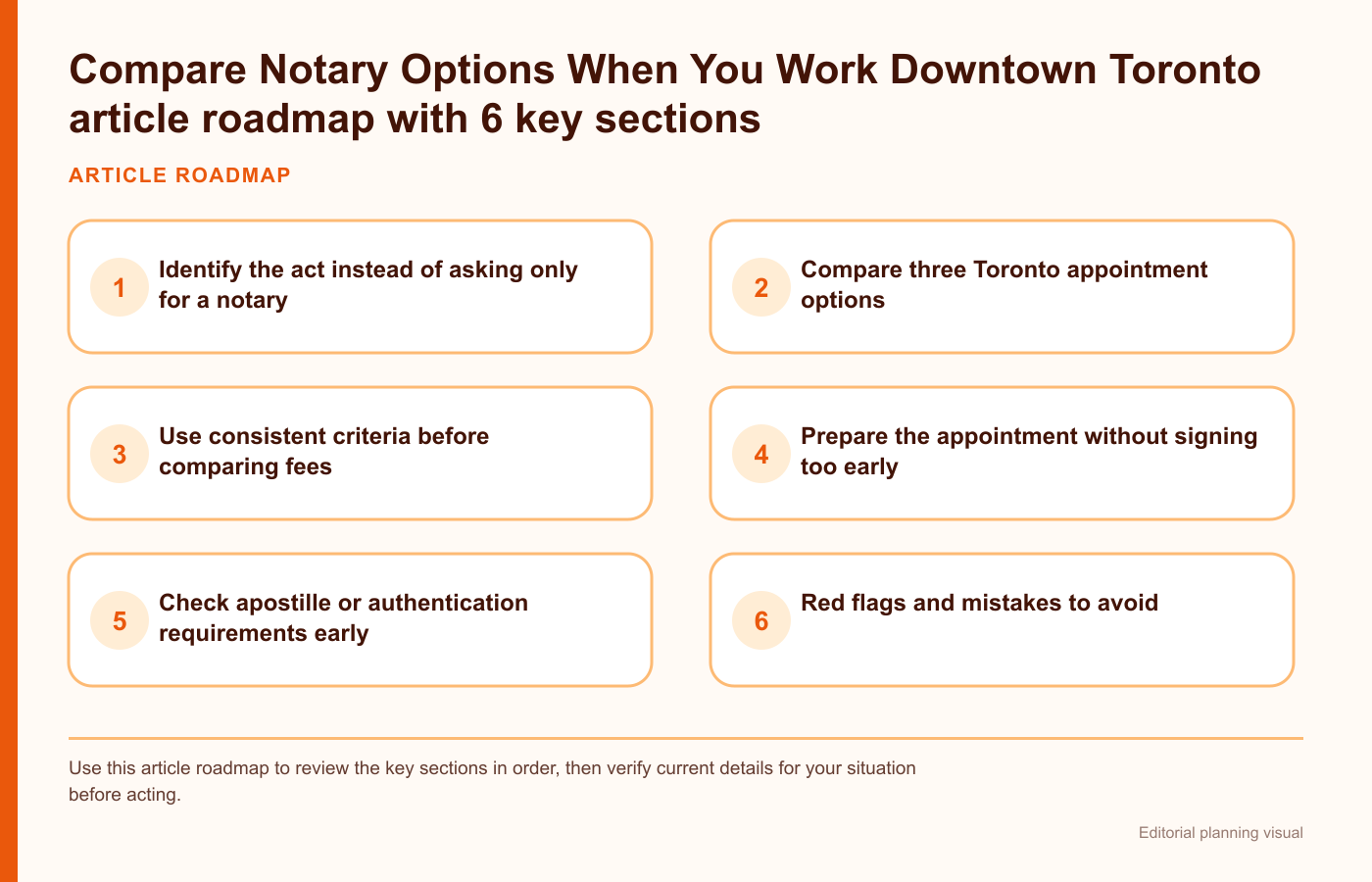
Identify the act instead of asking only for a notary
Ask the organization receiving the document to name the service it requires and provide written instructions if available. “Get this notarized” may mean several different things in ordinary conversation. The recipient may want an original signature witnessed, an affidavit commissioned, a certified copy, an identity declaration or a notarized document that will later go through an apostille process. The document itself, destination and receiving authority matter.
Ontario explains the distinction on its page for finding a notary public or commissioner of oaths. A commissioner can administer oaths and take affidavits or declarations within their authority. A notary public has those powers and can also verify signatures, marks and copies as true or genuine. That distinction is a useful starting point, but it does not tell you whether a particular provider can complete your specific document.
Write down five facts before searching by location: the document name, the required act, who issued it, where it will be submitted and the submission deadline. Note whether original papers, multiple signers, witnesses, translation, legal advice or an additional authentication step may be involved. These facts let a provider screen the request without guessing.
Compare three Toronto appointment options
Downtown in-person provider. This can be convenient around a workday, especially when the document, original identification or recipient calls for physical attendance. The trade-off may be appointment availability, walking time, building access and privacy in a busy setting. Confirm the exact address and service before travelling; a website that serves Toronto does not necessarily have an office in the downtown core.
Outside-core law office. Travel may take longer, but a law-office appointment can be useful when the document raises questions beyond a simple notarial act or when parking and a scheduled consultation matter. A notarial service and legal advice are different scopes and may have different fees. Ask which one is being booked. Vikram Sharma Law’s current owned notary public services page identifies Toronto and Etobicoke context; this article does not represent the firm as having a downtown Toronto office.
Potentially eligible remote commissioning. Ontario permits remote administration of an oath or declaration when the conditions in the current remote-commissioning regulation are satisfied, including real-time communication and identity confirmation. That does not mean every notarial act, document or receiving body accepts a remote process. Screen the exact document with both the provider and recipient before choosing convenience over an in-person appointment.
| Criterion | Downtown in person | Outside-core law office | Remote commissioning |
|---|---|---|---|
| Strongest fit | Physical attendance and minimal workday travel | Scheduled setting or possible related legal need | Eligible oath or declaration with recipient acceptance |
| Confirm first | Exact office, appointment and building access | Travel, scope and whether advice is included | Legal eligibility, technology and acceptance |
| Originals and copies | Ask what to bring and what will be examined | Ask what to bring and whether copies are prepared | Ask how originals, copies and completed files are handled |
| Main limitation | Proximity does not prove service capability | More travel does not guarantee broader scope | Not suitable or accepted for every request |
Use consistent criteria before comparing fees
Start with authority and scope. Ask, “Can you perform the exact act named in these recipient instructions?” Then confirm who will meet you and whether any limits apply. If the paper contains unfamiliar legal consequences, ask whether you need independent legal advice before signing. A notary’s identity check or witnessing function does not automatically include advice about the agreement.
Next, compare acceptance risk. The receiving organization—not the provider’s convenience claim—decides what it will accept. Ask whether it requires an original ink signature, a particular certificate, a seal, a witness, a copy of identification or a specific form of wording. For remote work, ask how identity, real-time communication, the jurat or declaration, file exchange and the record of the transaction will be handled.
Compare the complete appointment, not a headline fee. Relevant questions include the number of documents, signatures, signers, certified copies and appointments; urgent handling; printing or scanning; travel or parking; and whether taxes or legal advice are separate. Current pricing should come from the provider after it reviews the request. Do not rely on an old search snippet for a document-specific quote.
Finally, assess privacy and accessibility. Will the conversation occur in a private setting? Can every signer participate and communicate clearly? Does anyone need language assistance or an accommodation? A provider may need to pause if identity, willingness, understanding or communication cannot be established. A convenient appointment is not successful if the process cannot be completed properly.
Prepare the appointment without signing too early
- Get the recipient’s current instructions and confirm the required act.
- Send a blank or unsigned review copy only through a method the provider approves; redact unrelated sensitive data where appropriate.
- Ask what original identification and supporting papers each signer must bring.
- Confirm whether the document must remain unsigned until the appointment.
- Confirm whether witnesses are required and who may act as one.
- Ask how corrections, copies, scans, seals and completed originals will be handled.
- Confirm the location or remote link, time, accessibility and total scope-based fee.
- After completion, inspect names, dates and certificate fields before leaving or submitting the file.
Do not change a document based on a blog. If instructions conflict, return to the issuing or receiving organization or seek qualified legal advice. Bring more time than the signature itself appears to require; identity review, oath or declaration wording, multiple pages and copies can add steps.
Check apostille or authentication requirements early
Documents intended for use outside Canada may need more than a notarial act. Global Affairs Canada’s current authentication and apostille guidance explains that an apostille or authentication addresses the genuineness of a public official’s signature. It also says documents notarized in Ontario are routed to Ontario’s competent authority. This is a separate step from deciding what the destination organization wants notarized.
Before the appointment, contact the foreign authority, consulate or recipient and ask which original, translation, notarization, apostille or other steps it requires. Confirm the order. A notarial act completed in the wrong form can create avoidable rework even when the signature itself is genuine. Do not assume every Apostille Convention country applies the same document-specific process.
If a translation is involved, ask who may translate it and whether the translator’s declaration or credentials need separate handling. Keep names consistent across identification, source documents and translations, and flag differences before the appointment.
Red flags and mistakes to avoid
- Choosing only by “near me.” A nearby provider may not perform the required act or have the appointment format you need.
- Signing in advance. Some documents must be signed in the provider’s presence. Ask before signing.
- Calling every service notarization. Commissioning, copy certification, witnessing, notarization, legal advice and apostille are not interchangeable.
- Assuming remote means universally accepted. Confirm both legal eligibility and recipient acceptance.
- Bringing incomplete identification. Ask what originals and supporting records are required for each signer.
- Relying on an old online price. Obtain a current scope-based quote for the number and type of documents.
- Leaving international requirements until last. The destination may dictate format and sequence.
Frequently asked questions
Is a commissioner of oaths the same as a notary public?
No. Ontario describes overlapping but different powers. A commissioner can take affidavits and declarations within their authority; a notary public also has powers that can include verifying signatures, marks and copies. Ask the recipient which act is required.
Can every document be notarized online in Ontario?
No universal conclusion should be drawn. Ontario permits remote commissioning of eligible oaths and declarations when regulatory conditions are met, but the requested act and recipient’s acceptance still control. Ask both the provider and recipient.
Does Vikram Sharma Law have a downtown Toronto office?
This article makes no such claim. The firm’s owned notary page provides current Toronto and Etobicoke context. Confirm its current office address, appointment options and travel fit directly before booking.
Choose a next step with Vikram Sharma Law
Prepare a concise request with the unsigned document name, required act, receiving organization, destination, deadline, number of signers and whether originals or legal advice may be involved. Review the firm’s practice areas only if the matter may require advice beyond the notarial service.
Use Vikram Sharma Law’s current website to confirm the appropriate contact route, office location, appointment format, identification, scope and fee. If the requested act or acceptance is unclear, pause the booking and obtain written instructions from the recipient. That single check is often more valuable than choosing the closest map result.
General information for Ontario readers, not legal advice. Requirements depend on the document, provider’s authority, receiving organization, jurisdiction and current law.