
 26 June 2026
An affidavit of common law marriage is a sworn, notarized statement confirming a genuine, marriage-like relationship when you don’t have a civil marriage certificate. It’s used to prove status for benefits, banking, housing, and immigration. In Etobicoke, you typically sign before a notary public or commissioner after presenting valid ID and evidence.
By Vikram Sharma, Barrister, Solicitor & Notary Public — Vikram Sharma Law Professional Corporation
Last updated: 2026-06-26
At a Glance: Quick Summary
A common law marriage affidavit is a notarized statement confirming a genuine, ongoing common-law relationship. It’s accepted by many institutions when you need proof of partnership for benefits, insurance, housing, banking, or immigration. Prepare government ID and relationship evidence, then sign in front of a notary to finalize.
This overview helps you decide if this document is right for you and what to bring to your appointment in Etobicoke. Keep your file simple, consistent, and ready to submit on the same day you sign.
- Purpose: verify a common-law relationship when no marriage certificate exists.
- Where to sign: notary public or commissioner for taking affidavits in Etobicoke.
- Bring: two valid photo IDs (total), plus at least three forms of relationship proof spanning 12 months.
- Use cases: HR benefits, banking changes, tenancy, and immigration support.
- Next step: confirm if the requester needs an affidavit or a statutory declaration.
What Is an Affidavit of Common Law Marriage?
An affidavit of common law marriage is a sworn, notarized statement confirming that two partners live together in a marriage‑like relationship. It’s used when no formal marriage certificate exists and institutions require verified proof of partnership for benefits, insurance, banking, housing, or immigration.
In practice, this affidavit fills the proof gap by creating an official, sworn record you can submit to private institutions and government programs. In Canada, you’ll often see a “statutory declaration of common‑law union” for public programs; both documents verify the relationship under oath, but a statutory declaration follows a specific legislative format.
For readers who need deeper background on the role of a commissioner and notary in swearing documents, see our plain‑English explainer on the oath commissioner guide and our overview of what a commissioner of oaths is.
Why This Affidavit Matters
This affidavit matters because many organizations need proof beyond verbal claims. A sworn, notarized declaration reduces fraud risk and lets HR, banks, landlords, and immigration officers rely on a standardized, verifiable document when no marriage certificate exists.
Here’s the thing: policy teams typically require a sworn statement plus corroborating documents. A notarized affidavit shows you understand the legal obligation to tell the truth. That’s why it’s widely requested by benefits administrators, lenders, and program officers across the GTA.
- Employee benefits: many plans allow adding a partner after 12 months of cohabitation; a sworn statement often appears on the checklist.
- Housing: landlords and co‑ops may request proof of occupancy, especially when adding a partner to a lease.
- Banking and insurance: joint account updates and beneficiary designations may require a sworn declaration.
- Immigration: common‑law sponsorships and related filings often reference sworn declarations plus documentary evidence.
If you’re unsure whether you need an affidavit or its cousin (a statutory declaration), our short guide on statutory declaration vs. affidavit walks through the differences and when each is preferred.
How the Process Works (Step-by-Step)
Gather IDs and relationship proof, complete a draft affidavit, and book a notary appointment. At the appointment, the notary verifies identity, administers an oath, and witnesses your signature. You leave with a signed, stamped, and sealed affidavit ready for submission.
A simple, organized workflow saves time. In our experience serving couples in Etobicoke, the right preparation trims your visit to under 20–30 minutes because everything is ready to sign in sequence—no second trip required.
- Confirm the exact form: ask the requester if they need a general affidavit or a statutory declaration. If they have a program form, use it.
- Collect valid ID: each partner brings one government‑issued photo ID (passport, driver’s license, PR card).
- Gather relationship proof: aim for 3–5 types that span at least 12 months (lease, utilities, insurance, bank/credit statements).
- Draft the affidavit: include full names, addresses, start date of cohabitation, and a concise relationship statement.
- Book a notary: choose a convenient Etobicoke location with walk‑in capacity. Our affidavits service page outlines what we can witness.
- Sign and swear/affirm: both partners attend if both must swear on the same document; otherwise one deponent may attend.
- Receive the notarized copy: keep the original safe and make 1–2 photocopies for submissions.
For a deeper walkthrough (with checklists), see our affidavit process guide. It covers identity verification steps and what to do if a name has changed recently.
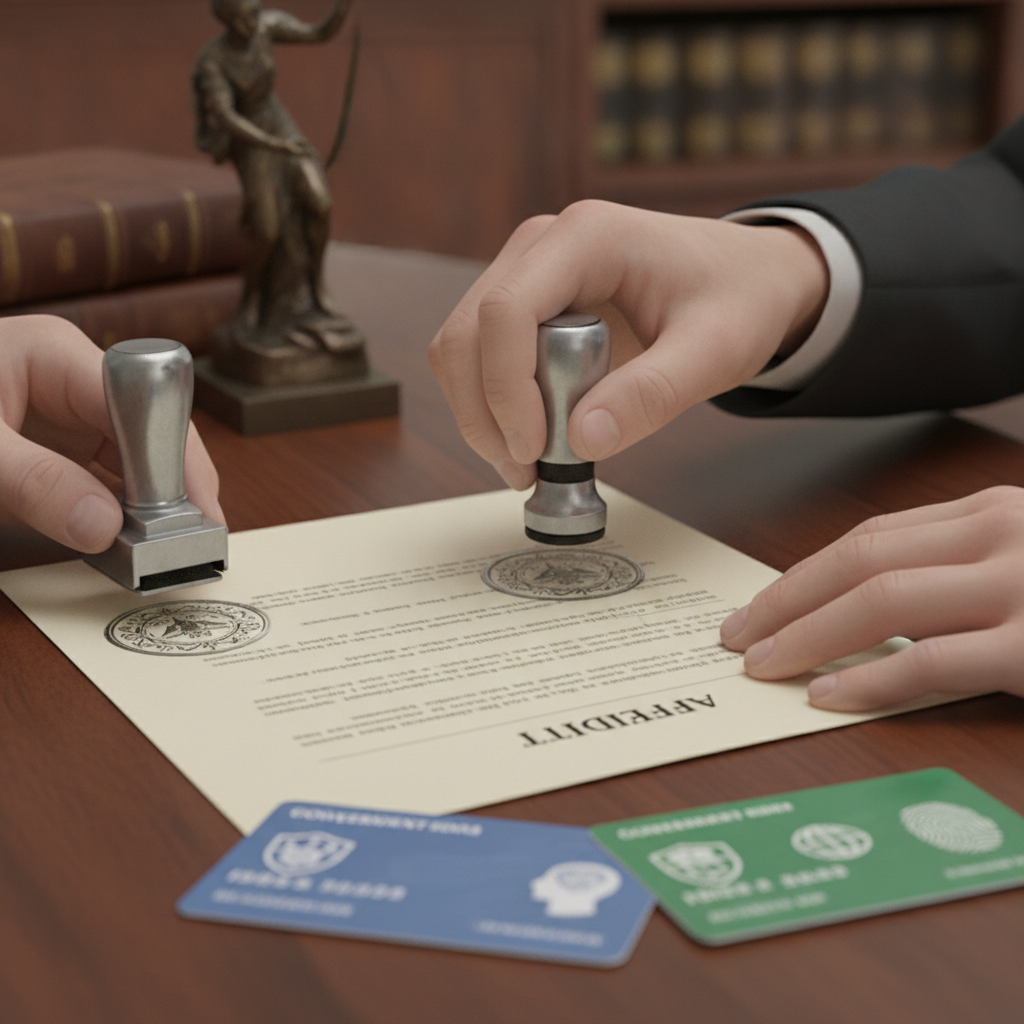
Types of Forms and Local Equivalents
You’ll encounter three main formats: a general affidavit of common law marriage, a statutory declaration of common‑law union for Canadian public programs, and program‑specific forms such as immigration templates. All require sworn statements, identity verification, and relationship evidence.
Titles vary, but the content stays consistent: who you are, where you live, when you started cohabiting, and that the relationship is exclusive and marriage‑like. Program forms can be very particular about wording, so follow their instructions exactly.
- General affidavit: flexible; often used for banking, insurance, and housing needs.
- Statutory declaration (Canada): used for federal or provincial programs; same idea, prescribed format.
- Immigration form: program‑specific templates designed for adjudication consistency.
- Single vs. joint signatures: some forms require both partners’ signatures; others use one deponent plus exhibits.
| Document | Main Use | Signature | Who Accepts |
|---|---|---|---|
| Affidavit of Common‑Law Marriage | Banking, benefits, housing | Notary + deponent(s) | Private institutions, landlords |
| Statutory Declaration of Common‑Law Union | Government programs | Commissioner/Notary + declarant(s) | Federal/provincial agencies |
| Program‑Specific Immigration Form | Immigration applications | As instructed | Immigration authorities |
If you’re preparing a statutory declaration, read our quick primer on what a statutory declaration is to avoid common formatting errors.
Best Practices for Proof
Bring at least three types of relationship evidence spanning 12 months or more: a residential lease, joint utility or internet bills, and banking or insurance documents showing the same address. Add photos, travel itineraries, or mail as secondary proof.
From our files in Etobicoke, the strongest submissions pair 3–5 primary documents with consistent dates and spelling. Think continuity: documents across multiple months tell a more convincing story than a single snapshot.
- Primary proof: lease/mortgage, utility bills, joint bank/credit accounts, insurance, tax records.
- Secondary proof: mail to each partner at the same address, dated photos, travel bookings, package deliveries.
- Continuity: show documents across at least 6–12 months; if you moved, include both old and new addresses with dates.
- Consistency: make sure names, unit numbers, and dates match your sworn start date of cohabitation.
Need help organizing exhibits and labeling them properly? Our step‑by‑step affidavits of documents guide explains exhibit stamps, initials, and sequencing so reviewers can find what they need fast.

Tools, Forms, and Resources
Use a prepared affidavit template, an evidence checklist, and a scheduling link for notary services. Program‑specific forms and public guides explain exact wording, acceptable IDs, and whether a statutory declaration is required instead of a general affidavit.
The right tools prevent omissions. Templates capture critical fields, checklists reduce back‑and‑forth, and program forms align your file with the reviewer’s expectations. Two partners, one organized folder, and a 10‑minute pre‑appointment review go a long way.
- Grab a template tailored to affidavits and statutory declarations so you don’t miss a required clause.
- Follow an evidence checklist: IDs, lease/mortgage, utilities, joint financials, insurance, tax slips.
- Use a local notary with walk‑in capacity to finish in one visit; our affidavits service page explains on‑site witnessing.
- For immigration‑specific context on common‑law sponsorships, review this immigration sponsorship overview.
Curious what notaries actually do at the table (and what they don’t)? This clear explainer on notary public services explained covers identity checks, oaths, and sealing.
Need one‑and‑done notarization? We help Etobicoke couples finish their affidavit or statutory declaration in a single, organized visit. Bring your IDs and documents—we’ll guide the oath and sealing process.
Book your affidavit witnessing and arrive prepared with our checklist guide.
Case Studies and Examples
Most approvals come from files that pair a clear sworn statement with consistent documents over time. The strongest examples show a lease, utilities, and joint financials spanning several months, plus photos or travel records to illustrate real‑life continuity.
Below are anonymized scenarios from our Etobicoke practice. They show how slight differences in facts change which documents to include, while the affidavit core remains the same.
Couple A: New to Etobicoke
They relocated for work and signed a 12‑month lease. We attached the lease, first internet bill, and two paystubs with the new address. The affidavit referenced the move‑in date and confirmed the relationship began 18 months earlier in another city.
- Primary exhibits: lease, internet bill, paystubs.
- Secondary exhibits: dated photo at move‑in, mail to each partner within the first month.
- Result: accepted by the landlord and used for HR benefits enrollment.
Couple B: Separate Finances, Shared Home
They kept banking separate but shared two utilities and renter’s insurance. We added individual mail and tax slips to show the same address. The record spanned 9 months at one address plus 5 months at a previous address.
- Primary exhibits: utilities, renter’s insurance.
- Secondary exhibits: personal mail and tax slips to each partner.
- Result: used successfully for joint insurance updates and a co‑op application.
Couple C: Immigration Support
One partner needed support for an immigration program that required a statutory declaration format. We followed the program’s template, added 6 months of bank statements showing the same address, and included 10 dated photos across family events.
- Primary exhibits: program form, bank statements, lease.
- Secondary exhibits: dated travel itineraries and photos.
- Result: submission accepted for initial review; no request for more documents.
For more affidavit types (like support affidavits), see our concise affidavit of support guide for formatting tips you can adapt.
Local Etobicoke Tips and Logistics
Plan your visit around transit and document access. Many clients combine a notary stop with errands near local landmarks, and they bring both originals and copies. Expect to present valid ID and sign in person; virtual options depend on the form and rules.
Local considerations for Etobicoke
- Pair your appointment with errands near Martin Grove Mall to grab any missing printouts or photocopies before you sign.
- During winter, road conditions can slow errands; budget an extra 15–20 minutes so you’re not rushed while reviewing the affidavit language.
- If you study or work near the Humber Centre for Trades & Technology, coordinate schedules so both partners attend together when dual signatures are required.
Need details on who can witness your oath locally? Our short read on commissioners of oaths in Etobicoke explains eligibility and the ID checks you should expect at the table.
Common Mistakes to Avoid
Don’t sign the affidavit before you meet the notary, don’t bring expired IDs, and don’t rely on only one month of proof. Inconsistencies in names, dates, or addresses are the top reasons administrators ask for resubmissions.
Small errors create large delays. Confirm the document type in advance, bring current ID, and verify dates across your lease, utilities, and banking/insurance records. Keep unique name spellings (including hyphens) identical across every page.
- Pre‑signed documents: a notary can’t validate a signature made outside their presence.
- Expired ID: most requesters require current, government‑issued photo ID; check the expiry date a week before your visit.
- Thin evidence: one bill is rarely enough; provide at least 3 different document types.
- Mismatched details: inconsistent unit numbers or name spellings raise flags and trigger follow‑ups.
Still unsure whether you need an affidavit or a statutory declaration? This short explainer on which one you need offers a quick decision path.
Frequently Asked Questions
These FAQs cover the who, what, and how of common‑law affidavits—what they prove, where to sign, and what evidence strengthens your file. Use them to prep for your appointment and minimize repeat visits.
Is an affidavit of common law marriage the same as a statutory declaration?
They’re closely related. An affidavit is a sworn statement notarized by a notary public or commissioner. A statutory declaration is a similar sworn statement prescribed by legislation and often used for public programs. Follow the format the requester specifies.
What documents should we bring as proof of our relationship?
Bring valid photo ID for each partner and at least three types of relationship proof: a lease or mortgage, utility or internet bills, and joint financial or insurance documents. Add mail, tax slips, and dated photos for extra support and continuity.
Can we sign the affidavit online?
It depends on the form and rules. Some documents permit remote commissioning; others require in‑person signatures. Confirm with the requesting institution before booking any online notarization to avoid re‑signing later.
Do we both have to attend the notary appointment?
If the form requires both partners to swear on the same document, yes. If it’s a single‑deponent affidavit, one partner may attend. Read the form notes first so you schedule correctly and avoid a second visit.
Will every institution accept a general affidavit?
Not always. Some programs require their own statutory declaration or a program‑specific form. Use the exact document requested and supplement with consistent evidence across multiple months.
Conclusion and Next Steps
To finalize a common‑law affidavit quickly, confirm the exact form required, organize at least three types of evidence, and sign in front of a notary with valid ID. Keep originals safe and submit clear copies as instructed.
- Key Takeaways: verify the document type, bring 3–5 proofs spanning 6–12 months, and avoid pre‑signing.
- Action Steps: book a notary, print and label exhibits, and attend together if both signatures are needed.
- Where we help: walk‑in notarization and exhibit labeling so you can submit the same day.
Ready to finish this in one visit? Book a local appointment with our affidavits service in Etobicoke. We’ll guide you through the oath, witness the signature, and seal the document—start to finish.