 22 February 2026
You’ve worked hard to build a life in Canada. Now you’re ready for the final step—citizenship. Here’s the thing: most delays happen not because people are ineligible, but because they miss small details. This complete guide—written for newcomers across the Greater Toronto Area and led by the Immigration Law and Notary Public teams at Vikram Sharma Law Professional Corporation (23 Westmore Dr. Unit #218A, Toronto)—explains citizenship application requirements Canada in plain English, with step-by-step actions you can follow today.
- What you’ll get here:
- A simple breakdown of eligibility, including the 1,095-day physical presence rule.
- Clear, scannable checklists for documents, translations, and certified copies.
- A step-by-step roadmap from “thinking about it” to your oath ceremony.
- Pro tips that prevent request letters, returns, and rescheduling headaches.
- Local, Toronto-specific insight so you can plan logistics with confidence.
- Citizenship application requirements Canada center on PR status, 1,095 days of physical presence in the last 5 years, relevant tax filings, language and knowledge (ages 18–54), and no prohibitions.
- Common blockers: uncounted trips, inconsistent names/addresses, missing translations or affidavits, and outdated forms.
- We help you reconcile travel history, organize certified true copies, and prepare for the test, interview, and oath—available in English, Hindi, and Punjabi.
Quick Answer
Most applicants qualify for Canadian citizenship if they’re permanent residents with at least 1,095 days in Canada in the last five years, have filed taxes when required, and (ages 18–54) meet language and knowledge standards. Near Toronto? Our team at 23 Westmore Dr. Unit #218A reviews eligibility, organizes documents and translations, and guides your submission from start to oath.
Table of Contents
- Summary
- What Is Canadian Citizenship?
- Why These Requirements Matter
- How the Citizenship Process Works
- Citizenship Application Requirements Canada (Core Criteria)
- Types of Applications and Special Paths
- Comparison: Grant vs. Proof vs. Minor Applications
- Step-by-Step: Apply for Canadian Citizenship
- Documents Checklist (with Translation & Notarization Tips)
- Best Practices to Avoid Delays
- Tools & Resources
- Case Studies & GTA Examples
- FAQ
- Key Takeaways
- Conclusion
Summary
- Eligibility highlights:
- Permanent resident status (not under review or removal).
- 1,095 days of physical presence in the 5 years before you apply.
- Income tax filings for at least 3 years in that period, if required to file.
- Language ability and knowledge test for ages 18–54.
- No prohibitions (certain criminal/immigration issues can pause eligibility).
- What slows people down: Travel-day miscounts, mismatched names/addresses across IDs, missing certified translations, and incomplete forms.
- How we help: Eligibility audit, travel timeline reconstruction, form completion, translations, affidavits, certified true copies, and ceremony prep—delivered in English, Hindi, and Punjabi.

What Is Canadian Citizenship?
Citizenship is a legal status that grants full political rights and a Canadian passport. It’s different from permanent residency: PR can require ongoing residency obligations to keep your status; citizenship does not.
- Key benefits:
- Vote in federal, provincial, and municipal elections.
- Apply for a Canadian passport and get consular assistance abroad.
- Run for elected office and participate fully in civic life.
- Key responsibilities:
- Comply with Canadian laws and duties arising from citizenship.
- Provide truthful, complete information during the application.
- Attend your test/interview and take the oath when invited.
Why These Requirements Matter
Requirements aren’t just checkboxes—they’re how officers confirm you’re settled in Canada and ready for civic participation. Skipping details risks long delays.
- Faster processing: A clean, consistent file moves through steps with fewer document requests.
- Reduced stress: Reconciling travel, names, and translations early makes deadlines (tests, oaths) easier to manage.
- Better outcomes: Strong preparation means fewer surprises at test, interview, or ceremony.
Want a quick overview first? Our internal page on citizenship eligibility explains the basics before you dive into this full guide.
How the Citizenship Process Works
Think of the process as a pipeline: eligibility → application → assessment → test/interview → decision → oath. Each stage has its own expectations and timing.
- Eligibility confirmation: Verify PR status, physical presence, tax years, and age-based requirements.
- Application submission: Complete the latest forms, sign/declarations correctly, and submit online or by mail.
- Background review: Officers verify your details and may request more documents to clarify travel, identity, or status.
- Test and interview (18–54): You complete the citizenship test (based on official study material) and may attend an interview.
- Decision: If approved, you’ll receive instructions for the oath ceremony.
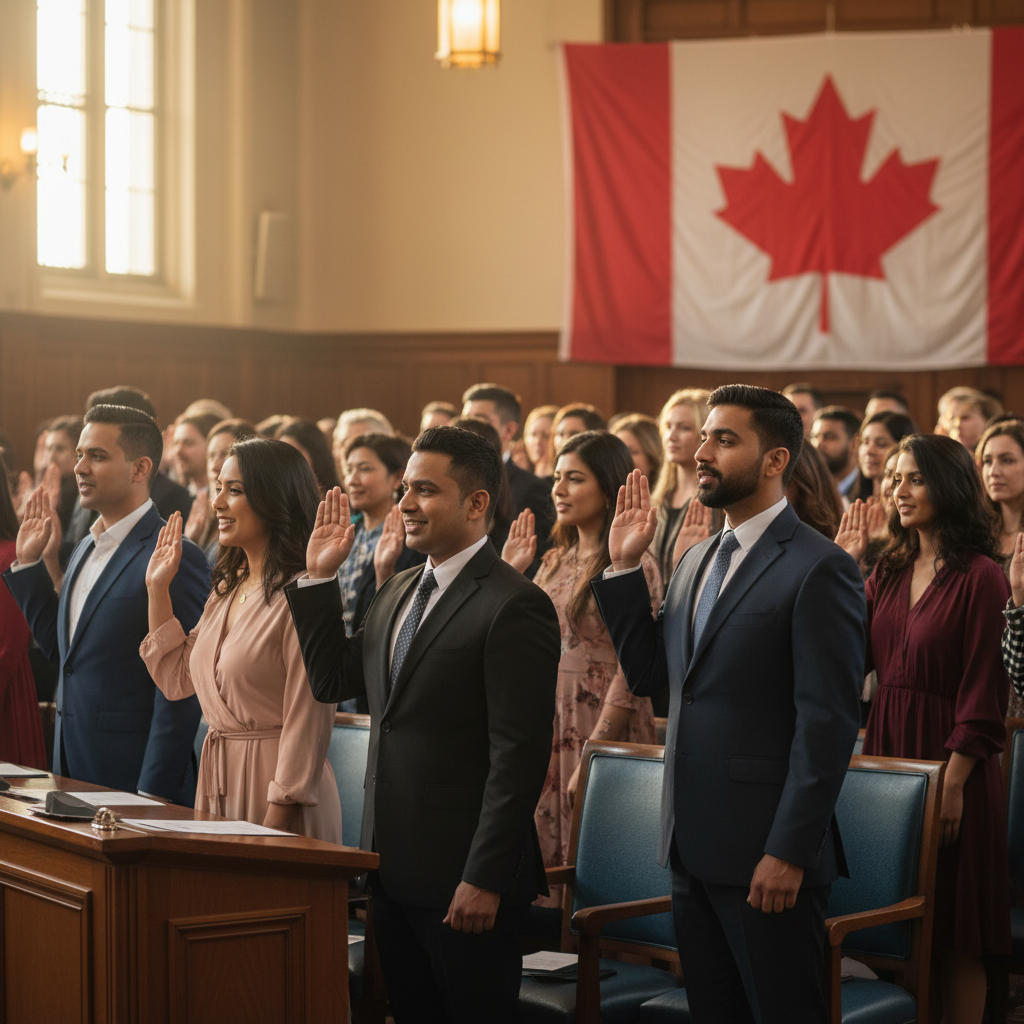
- Oath ceremony: You swear or affirm the oath, receive your certificate, and officially become a Canadian citizen.
Citizenship Application Requirements Canada (Core Criteria)
Here are the must-meet rules most adult applicants face. Use these to self-check before you start filling out forms.
- Permanent resident (PR) status
- Hold PR status that isn’t under review for fraud or subject to a removal order.
- An expired PR card is fine—PR status matters, not the card’s validity.
- Physical presence: 1,095 days in 5 years
- Be physically present in Canada for at least 1,095 days in the 5 years before signing your application.
- Time in Canada before PR may count as half-days (up to a limit) toward your total—use it if you’re just shy of 1,095.
- Income tax filings
- File taxes for at least 3 tax years within the 5-year window, if required to file for those years.
- Language ability (ages 18–54)
- Show adequate English or French ability with accepted proofs (language tests, Canadian education records, or other recognized evidence).
- Knowledge of Canada (ages 18–54)
- Pass the citizenship test covering history, rights and responsibilities, political systems, and symbols. Study the official guide.
- Prohibitions
- Certain criminal proceedings, probation/parole, imprisonment, or immigration findings can pause eligibility. Time your application strategically.
Nuances we often solve for clients
- Travel-heavy jobs: We reconcile stamps, ticket emails, and CBSA history to build a credible presence calculation.
- Name changes and multiple IDs: We align records with marriage/divorce certificates or legal name-change documents.
- Language proof without extra tests: Canadian schooling in English or French often satisfies the requirement—no need to book a new test.
Types of Applications and Special Paths
Your route depends on age, family situation, and whether you’re seeking a grant of citizenship or proof you already have citizenship by descent.
- Grant of citizenship (adults 18+): Standard path with presence, tax, language, knowledge, and oath requirements.
- Minors (under 18): May apply with or without a parent; minors don’t take the adult test or meet adult language rules.
- Proof of citizenship (by descent): For individuals who have a Canadian parent and need a citizenship certificate (not the grant process).
- Adopted persons: Specific documentation may be required depending on where and when the adoption occurred.
- Special circumstances: Statelessness, complex identity records, or past immigration findings may require tailored legal strategy.
Comparison: Grant vs. Proof vs. Minor Applications
| Type | Who It’s For | Core Requirements | Notes |
|---|---|---|---|
| Grant (Adult) | PRs 18+ | 1,095 days presence; taxes; language & knowledge (18–54); oath | Most common route for PRs seeking citizenship |
| Minor | Under 18 | Parent/guardian context; no adult test/language rules | Often filed alongside a parent’s application |
| Proof (by descent) | Persons with a Canadian parent | Evidence of parent’s citizenship and relationship | Results in a citizenship certificate (not a grant) |
Step-by-Step: Apply for Canadian Citizenship
Use this workflow to stay organized and avoid rework.
| Step | What to Do | Who Must Do It | Pro Tips |
|---|---|---|---|
| 1. Confirm eligibility | Check PR status, calculate days, confirm tax years, and review age-based rules. | All adult PRs | Short of 1,095? See if pre-PR days count as half-days. |
| 2. Reconstruct travel | List all trips for 5 years with exact dates; match stamps to boarding passes. | Adults and some minors | Fill gaps with airline emails or employer letters. |
| 3. Gather documents | IDs, PR docs, tax proofs, language evidence, name-change or civil status papers. | All applicants | Order certified translations now to avoid last-minute scrambles. |
| 4. Prepare copies | Make certified true copies where requested; draft affidavits if originals are missing. | As needed | Our Notary Public team handles copies and statutory declarations on-site. |
| 5. Complete forms | Use the latest application; sign, date, and answer every field (use “N/A” if not applicable). | Primary applicant | Triple-check names and dates—mismatches cause preventable delays. |
| 6. Submit and track | Submit online or by mail; save receipts; monitor requests and deadlines. | All applicants | Create inbox filters so you never miss appointment notices. |
| 7. Prepare for test/interview | Study the official guide; review rights/responsibilities; bring required IDs. | Ages 18–54 | Short daily sessions beat cramming the night before. |
| 8. Oath ceremony | Attend on time, bring IDs, and celebrate becoming a Canadian citizen. | Approved applicants | Confirm dress code and guest rules in advance. |
- We audit travel history and calculate days with you.
- On-site notarization: certified true copies and statutory declarations the same day.
- Service in English, Hindi, and Punjabi so nothing gets lost in translation.
Documents Checklist (with Translation & Notarization Tips)
- Identity & PR status
- PR card (valid or expired), Confirmation of Permanent Residence, or Record of Landing.
- Primary photo ID: passport(s), driver’s license, or provincial ID card.
- Travel history
- Current and previous passports with all pages.
- Boarding passes, e-tickets, or employer letters to fill stamp gaps.
- Optional: CBSA travel history if your records are incomplete.
- Language (ages 18–54)
- Recognized test results, or Canadian school transcripts/diplomas in English or French.
- Tax filings
- Notices of assessment or other proof you filed for at least 3 tax years in the window (if required).
- Name & civil status
- Birth certificate, marriage certificate, divorce order, or legal name-change documents.
- Certified translations for non-English/French documents; include translator affidavit where applicable.
- Special scenarios
- Adoption records if applying as an adopted person.
- Proof of parent’s Canadian citizenship if seeking proof (by descent).
For a fast primer on certifications and seals, see our internal explainer on what notaries actually do so you submit exactly what officers expect.
Best Practices to Avoid Delays
- Build a five-year travel grid: Dates in one column, destinations in another, and notes on stamps or tickets. Gaps? Add airline emails.
- Standardize names and addresses: Use legal documents to explain any changes so your IDs tell one story.
- Use Canadian schooling as language proof: It’s often enough. Keep transcripts ready.
- Answer every field: Use “N/A” when something doesn’t apply—blank fields invite questions.
- Keep originals accessible: You may need them for test/interview or ceremony checks.
- Scan everything: Store PDFs of forms, receipts, and confirmations in a secure cloud folder.
- Watch your email: Set filters for appointment letters and document requests so you never miss a deadline.
Tools & Resources
- Service overview: Learn how we handle eligibility checks, forms, and oath prep in our Immigration Law services.
- Narrative walkthrough: Compare your plan with this internal citizenship step-by-step guide.
- Still on PR? Prep early using our internal PR process overview to set the stage for citizenship later.
Case Studies & GTA Examples
Realistic, anonymized scenarios from clients in Toronto, Brampton, Mississauga, and Vaughan.
- 1) Consultant with monthly cross-border trips: We matched stamps to ticket emails and confirmed 1,120 days—enough buffer for approval.
- 2) New grad using school transcripts: Ontario high school and college records satisfied language proof; no extra test needed.
- 3) PR card expired, still eligible: With PR status intact and 1,200+ days, we filed confidently and moved to testing quickly.
- 4) Parent and minor applying together: We labeled the minor’s package clearly and included translated birth docs with affidavit.
- 5) Married name change: We attached the marriage certificate and updated IDs; zero name-mismatch requests.
- 6) Entrepreneur with scattered records: We reconstructed travel from meeting invites and loyalty emails—presence threshold met.
- 7) Proof by descent: A client with a Canadian parent needed a proof certificate. We focused on lineage evidence, not the grant process.
- 8) Adoption abroad: We compiled adoption orders, translations, and affidavits—application accepted at first review.
- 9) Test anxiety: We created a two-week study plan using short sessions; the client passed comfortably.
- 10) Document set not in English/French: Our Notary Public Services coordinated certified translations and sworn statements—no follow-up requested.
- 11) Employment travel spike during one year: We advised waiting two extra months to add buffer days—approval followed without timing risk.
- 12) Mismatch between passport and driver’s license: We added a simple name-variance affidavit—file processed smoothly.
Local Tips
- Tip 1: Driving to our Etobicoke office near Highway 27 and Finch Ave W? Budget extra time during rush hour and airport traffic from the 427.
- Tip 2: Winter appointments can shift around storms. Keep digitized copies handy for quick resubmissions or rescheduling proofs.
- Tip 3: Combine services: book immigration review and same-day notarization at 23 Westmore Dr. Unit #218A to avoid multiple trips.
IMPORTANT: These are real-world logistics we help clients manage across the GTA.
FAQ
How do I count my 1,095 days for physical presence?
Create a five-year calendar and enter every trip’s departure and return dates. Reconcile against passport stamps, boarding passes, and email receipts. Some pre-PR time may count as half-days (up to a cap). If records don’t align, we help rebuild a credible travel timeline.
Do I need to renew my PR card before applying?
No. You need valid PR status, not a valid PR card. If you meet presence, tax, language/knowledge, and prohibition rules, you can apply. Keep your IDs organized for test/interview and oath day checks.
What language proofs are accepted for ages 18–54?
Recognized test results, Canadian secondary or post-secondary education in English or French, or other accepted evidence. If you studied in Canada in English or French, transcripts or diplomas often satisfy the requirement.
What if my documents aren’t in English or French?
Provide certified translations and, where required, translator affidavits. We routinely handle certified true copies, statutory declarations, and translation packages through our Notary Public Services in Toronto.
How should I study for the citizenship test?
Use the official guide and practice questions. Focus on history, symbols, rights/responsibilities, and government structure. Short daily reviews for two weeks generally beat last-minute cramming. Bring required IDs and arrive early on test day.
Key Takeaways
- Citizenship application requirements Canada revolve around PR status, 1,095 days in five years, tax filings, and (ages 18–54) language and knowledge.
- Most delays come from travel miscounts, inconsistent IDs, and missing translations—not eligibility.
- Handle notarization, certified copies, and affidavits together to keep your file clean.
- Legal guidance keeps the process moving and prevents avoidable requests and rescheduling.
Conclusion
- Confirm eligibility early and build a clear five-year travel record.
- Gather IDs, PR proofs, tax years, and language evidence before you touch the forms.
- Standardize names and addresses across all documents.
- Prepare for the test with short, steady study sessions and keep originals ready.
- Want a done-with-you approach? Explore our Immigration Law services to move from checklist to oath with confidence.
- Visit us at 23 Westmore Dr. Unit #218A (near Highway 27 and Finch Ave W) or book a phone/video consult.
- Bring passports and travel proofs—we’ll calculate days and finalize your document plan.
- Need notarization or certified true copies? We coordinate it on-site the same day.