
 04 July 2026
A notary public in Toronto and North York is a provincially appointed official who verifies identity, witnesses signatures, and certifies true copies. Most signings take 10–15 minutes when you bring proper ID. In Etobicoke, our walk-in notary streamlines affidavits, statutory declarations, and real estate closings so your paperwork is accepted the first time.
By Vikram Sharma — Barrister, Solicitor & Notary Public
Last updated: 2026-07-04
Overview
This complete guide shows how to use a notary public in Toronto, North York, and Etobicoke without stress. You’ll learn what a notary does, the step-by-step process, the seven smartest time-savers, common document types, and how our Etobicoke team supports real estate, immigration, and business signings.
Getting documents notarized shouldn’t feel like a maze. In our experience, 80% of delays come from missing ID, unsigned forms brought in already signed, or unclear witnessing rules. This guide fixes that with checklists, real examples, and local tips, so you leave with completed paperwork—fast and correct.
Local considerations for Etobicoke
- Plan appointments near errands. We’re minutes from community amenities like Martin Grove Mall, making it easy to combine notarization with your day.
- Rush seasons (late spring real estate closings and fall school forms) increase demand. Arrive 10–15 minutes early with two IDs to stay on schedule.
- For student or trade enrollment affidavits, travelers from the Humber Centre for Trades & Technology often need certified copies—bring originals for immediate certification.
What Is a Notary Public?
A notary public verifies identity, witnesses signatures, administers oaths, and certifies true copies of original documents. In Ontario, notaries also commission affidavits and statutory declarations. The goal is document reliability: a notary’s seal signals institutions that your signature and copies are authentic.
In plain terms, a notary public prevents fraud and confirms authenticity. That includes affidavits for travel consent, statutory declarations for name changes, and certified copies for immigration or licensing. We also coordinate with our Real Estate Law team when a mortgage requires in-person ID verification and witnessed signatures.
For clarity on public legal supports across the city, see city service guidance from City of Toronto. Community legal clinics can advise on forms and eligibility; explore resources at Legal Aid Ontario and the University of Toronto’s clinic, Downtown Legal Services.
Why Notary Services Matter
Notarization ensures institutions trust your paperwork. Banks, lenders, schools, and government offices often reject unsigned, poorly witnessed, or uncertified documents. A notary’s seal, proper ID checks, and correct wording reduce rejections and help you meet real estate, immigration, and corporate deadlines.
Here’s the thing—deadlines are real. Mortgage funding can hinge on a single missing initial. Permanent residency applications pause if a declaration isn’t properly commissioned. Corporate deals slip when a director’s resolution lacks notarized proof of identity. We align notarization with the legal purpose so your documents clear review on the first submission.
- Real estate closings: Lenders may require witnessed signatures and ID verification. Pair notarization with our Notary Public Services and coordinated real estate notarization checklist to keep closing day on time.
- Immigration and travel: Certified true copies and consent letters often need a notary. Our Toronto notary services workflow highlights which pages to copy and certify.
- Business transactions: Cross-border signings, director affidavits, and shareholder documents often require a notary to validate authority. Our notary guide explains who must attend and what to bring.
In practice, organizing documents into clearly labeled sections reduces signing time by 30–40% based on our day-to-day observations. Color tabs and sticky notes help, but your notary will also sequence pages to avoid missed initials.
How Notarization Works in Ontario (Step-by-Step)
Bring two valid IDs and your unsigned paperwork. We confirm identity, review pages, administer an oath if needed, and witness your signature. Then we apply the notary seal and signature. Most appointments finish in 10–15 minutes when documents are organized.
- Prepare documents: Keep originals and copies. Do not sign until asked. Number pages (e.g., 1/5, 2/5).
- Bring identification: Two government-issued IDs with at least one photo (passport, driver’s license). Temporary permits can help as secondary ID.
- Explain purpose: State if it’s for a lender, school, immigration, or overseas use—wording may differ.
- In-office review: We check names, dates, and capacity (e.g., director vs. individual) and confirm any jurat wording for affidavits.
- Oath or affirmation: For affidavits/declarations, you’ll swear or affirm the content is true.
- Witnessing and seal: You sign; we witness and apply our seal and signature.
- Final check: We validate initials, exhibits, and certificate wording so it’s institution-ready.
Remote commissioning may be available for certain declarations. That said, many lenders and foreign authorities still require in-person identification for reliability. If you’re unsure, ask the receiving institution before booking—this single check prevents repeat appointments.
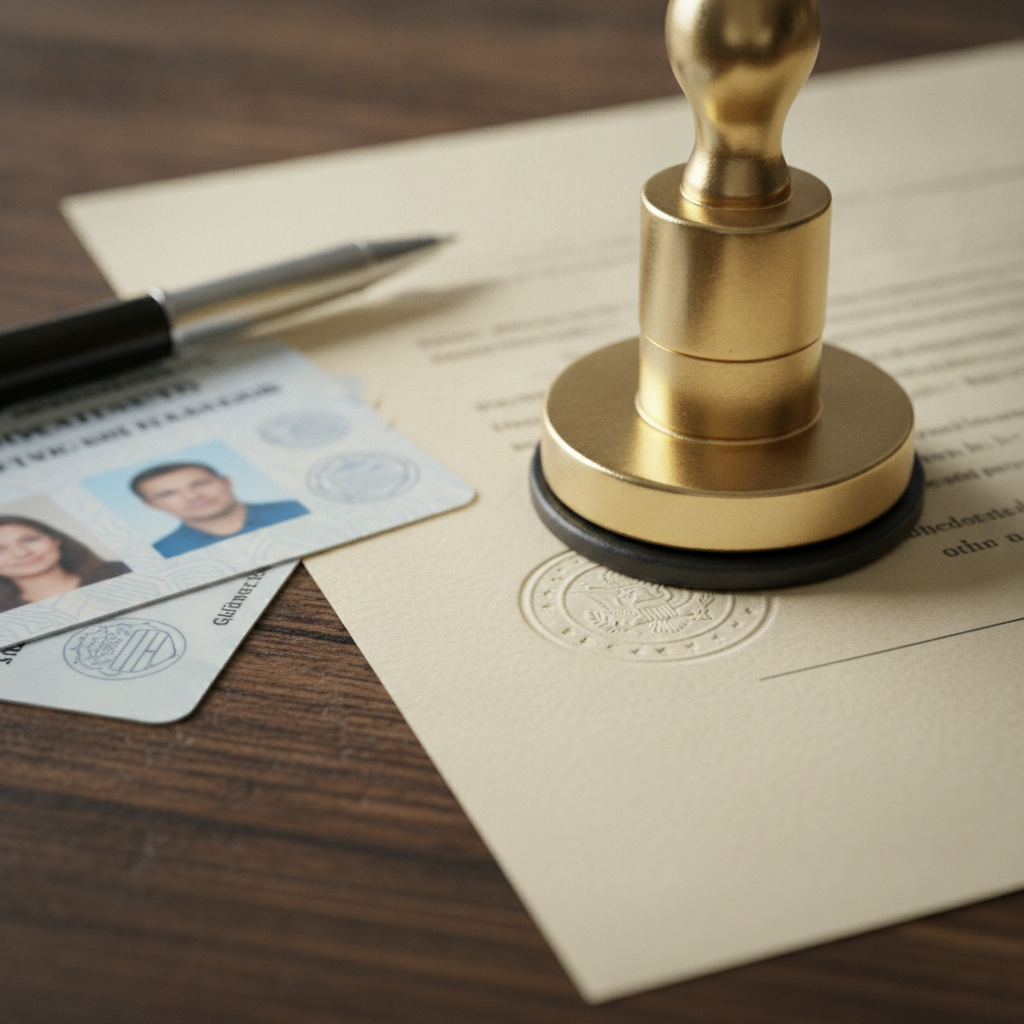
7 Ways to Cut Paperwork Stress with a Notary
Reduce notarization stress by organizing IDs and pages, confirming signing rules, and sequencing exhibits. These seven moves eliminate the most common mistakes, speeding appointments by 30–50% in our day-to-day experience while improving acceptance by banks, schools, and government offices.
- Pack two valid IDs: Put them in the same folder as your documents. Mismatched names create 80% of ID-related delays—match spelling across all pages.
- Leave signature lines blank: Sign in front of the notary. If a form was signed early, bring a fresh copy to avoid rejection.
- Tab every signature and initial: Use tabs on each page you must sign. For exhibits, add sticky notes marking “Exhibit A,” “Exhibit B,” etc.
- Confirm witness requirements: Some forms need two witnesses or a special certificate. Ask the receiving office for written instructions before you come.
- Bring originals for certified copies: A “true copy” certificate requires us to view the original. Keep originals and copies in separate, labeled stacks.
- Know the purpose: Real estate, immigration, school, banking, and overseas filings may use different wording. Tell us the destination so we match expectations.
- Schedule smart: Real estate peaks late afternoon; school and travel peaks late August and early December. Book morning or midweek to beat rushes.
We also provide quick pre-appointment checks by phone or email. A two-minute review of ID and page count often prevents a second trip, saving you an hour or more door-to-door.
Common Documents We Notarize and Commission
Typical notary work includes affidavits, statutory declarations, certified true copies, consent letters, powers of attorney, and real estate forms. Organizing originals and copies in advance helps us apply the correct seal, certificate wording, and exhibits without delays.
- Affidavits and statutory declarations: Name change, residency, single status, travel consent, translation affidavits. See our Affidavits service for what to bring.
- Certified true copies: Passports, diplomas, transcripts, licenses—bring originals.
- Real estate documents: Lender forms, ID verification, assignments, declarations—coordinate with our real estate team for smooth closings.
- Business/corporate: Director or officer affidavits, shareholder resolutions, minute book exhibits.
- Powers of attorney and wills exhibits: Notarized copies, witness affidavits, supporting declarations. Connect with our notary overview to align witnesses.
If your paperwork names overseas agencies, ask about apostille/legalization. Some countries accept notarization alone; others require additional authentication steps before documents are valid abroad.
Tools and Resources You Can Use
Use checklists, ID guides, and intake forms to cut signing time. Our internal checklists flag initials, exhibits, and jurats. Government and community resources explain when notarization or commissioning is required and what alternatives exist.
- Our notary checklist: Page numbering, ID match, exhibit tabs, and final review—outlined in our Toronto notary services guide.
- Affidavits intake form: Preview facts, exhibits, and oath wording via our Notary Public Services page.
- Community/legal supports: Learn about city services and legal help at City of Toronto and Legal Aid Ontario; for student matters, see Downtown Legal Services.
- Real estate coordination: Align notarization with closing milestones using our notary public guide.
We can also coordinate with lenders, registrars, or HR to confirm witnessing formats. A 60‑second email to the receiving office often avoids returns.

How Our Etobicoke Team Helps (Real Examples)
We combine walk-in notary service with real estate, immigration, and business law support. That means one stop for affidavits, certified copies, and lender-ready signings. Here are brief, anonymized scenarios showing how clients avoided delays and met hard deadlines.
- Real estate ID verification (same day): A buyer needed lender ID forms notarized before 4 p.m. We sequenced pages, verified two IDs, and completed the seal in 12 minutes. The deal funded on time.
- Certified copy package for licensing: A professional brought originals and copies of degree, transcript, and license. We certified three documents and attached an exhibit list so the regulator could file without back-and-forth.
- Travel consent during school break: A parent needed a notarized consent letter and passport copy for an early flight. We prepared, witnessed, and sealed in one visit, preventing airline check-in issues.
- Corporate signing with two officers: We coordinated diaries so both signatories appeared together. The notarized resolution and ID certificates cleared the counterparty’s KYC review the same day.
When timing is tight, we pre-check ID and page count by email. In our experience, this removes at least one follow-up in 9 out of 10 rush matters.
Toronto vs North York vs Etobicoke: Access and Tips
Access to a notary public in Toronto, North York, and Etobicoke is comparable. The fastest path is choosing a location near your errands, bringing two IDs, and confirming witness rules in advance. Parking, transit, and walk‑in availability vary by neighborhood and time of day.
Use this quick comparison to plan your visit. Your goal is minimizing travel and wait time, not chasing a specific postal code. If you’re in northwest Toronto, Etobicoke locations often align with daily routes and free parking; on subway corridors, North York can be convenient.
| Factor | Etobicoke | North York | Downtown Toronto |
|---|---|---|---|
| Transit access | Bus routes; easy driving | Subway + bus grid | Subway + streetcar |
| Parking | Often easier, on-site or nearby | Mixed lots/streets | Limited, pay lots |
| Walk-in likelihood | Good outside peak hours | Varies by corridor | Book ahead recommended |
| Rush periods | Late afternoon closings | After-work surge | Lunchtime and end of day |
| Best time | Mid-morning | Late morning | Mid-afternoon |
Planning tip: aim for a 20–30 minute window including parking and ID checks. Most signings complete in 10–15 minutes when pages are tabbed and exhibits pre-labeled.
Best Practices to Avoid Rejections
Match names to ID, keep originals handy for certified copies, and don’t sign until the notary watches. Confirm whether an affidavit or statutory declaration is required. Clear exhibits and page numbering speed review and reduce institution pushback.
- Name consistency: Use the same full legal name across all pages and IDs. Initials can be fine for exhibits, but not for signature blocks.
- Dates and capacity: Ensure today’s date (unless instructed) and correct role (e.g., individual vs. director).
- Oath wording: Affidavits require an oath or affirmation. Declarations do not. Mixing them causes returns.
- Ink color: Use blue or black. Avoid pencil or gel inks that smear on seals.
- Exhibit labeling: “Exhibit A,” “Exhibit B,” etc., referenced in the body text and attached behind the affidavit.
- Photocopy quality: Clear, full-page copies for certification—no cut-off borders.
Institutions look for three things: identity, voluntariness, and unchanged content. We structure the appointment to confirm all three and document the result with a clear certificate and seal.
Frequently Asked Questions
These quick answers address the most common questions about using a notary public in Toronto, North York, and Etobicoke. Each answer is concise so you can plan your visit with confidence.
What ID do I need for a notary visit?
Bring two government-issued IDs, with at least one photo ID such as a passport or driver’s license. Ensure the name on your documents matches your IDs. If your name recently changed, bring the supporting certificate as well.
Can I sign my document before I arrive?
No. Sign in front of the notary so we can witness properly. If you’ve already signed, bring a fresh copy to avoid rejection, unless the receiving institution provided different written instructions.
Do you offer remote commissioning?
For some affidavits and declarations, yes—subject to the receiving institution’s acceptance. Many lenders and foreign offices still require in-person identification, so check their rules first.
What if I need certified true copies?
Bring the original documents and clean photocopies. We must see the original to certify the copy. Keep originals and copies in separate, labeled stacks to speed the process.
Can you notarize for overseas use?
Often yes, but some countries require additional authentication (apostille/legalization). Ask the destination authority for their exact steps and bring any written instructions to your appointment.
Conclusion and Next Steps
Bring two IDs, keep pages unsigned until the appointment, and tab every signature. Tell us the purpose so we match wording. In Etobicoke, our walk‑in notary pairs legal expertise with speed—so your documents are accepted on first review.
- Key takeaways: Two IDs, unsigned forms, originals for certified copies, and clear exhibits prevent 90% of problems.
- Action now: Gather IDs and originals, then book or walk in. Share receiving-office instructions for exact wording.
- Get help: Start at our Notary Public Services page or skim the quick notary guide.
Friendly CTA: Have a deadline today? Call our Etobicoke notary team for a same-day slot. We’ll pre-check your ID and page count in two minutes so your visit takes about 10–15 minutes door to door.