 10 May 2026
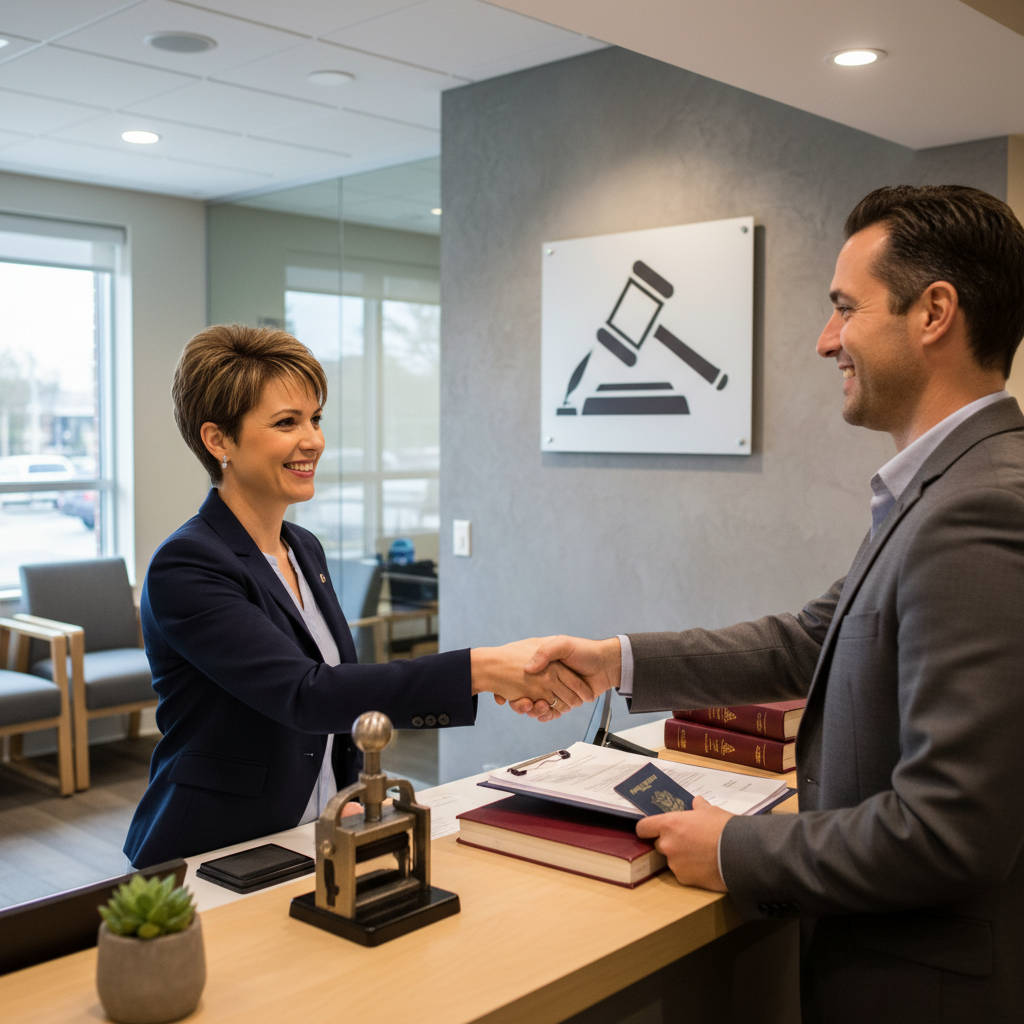
An oath commissioner is a person authorized by law to witness the swearing or affirming of affidavits and statutory declarations. They verify identity, confirm the signer understands and swears the contents, and then sign and stamp the document. For Etobicoke residents, you can walk into 23 Westmore Dr Unit #218A (2nd Floor) to get this done quickly.
By Vikram Sharma — Barrister, Solicitor & Notary Public
Last updated: 2026-05-10

Above-Fold Summary and Guide Map
Use an oath commissioner when you need an affidavit or statutory declaration sworn or affirmed. Bring valid photo ID, unsigned documents, and know what you’re declaring. This guide explains what commissioners do, how the process works, required documents, best practices, and how to visit our Etobicoke office for same-day commissioning.
This complete guide is designed for individuals and businesses who need documents commissioned without delays. You’ll learn:
- What an oath commissioner does and how commissioning differs from notarization
- When you need an affidavit vs. a statutory declaration
- The step-by-step commissioning process in Ontario
- How to prepare, what ID to bring, and signature rules
- Local tips for Etobicoke and the Toronto metro area
You can get help in person at Vikram Sharma Law Professional Corporation in Etobicoke, or review our Affidavits service page for details.
What Is an Oath Commissioner?
An oath commissioner (commissioner for taking affidavits) is authorized to witness swearing or affirming of written statements. They verify identity, confirm the declaration is voluntary, and apply a signature and stamp. Commissioners do not verify the truth of contents—they witness the oath or affirmation only.
In plain terms, a commissioner for taking affidavits helps you legally swear or affirm that a document’s contents are true. They ensure you show valid identification, understand what you’re signing, and sign in their presence. Then they sign and apply their commissioner stamp or seal.
- Primary role: Witness your oath/affirmation and signature on affidavits or statutory declarations.
- What they don’t do: They don’t certify copies as true (that’s a notary) and don’t provide legal advice unless they’re also a lawyer.
- Where used: Real estate closings, family law matters, immigration packages, business filings, travel consent letters, and insurance claims.
At our Etobicoke office, commissioning often supports our core services—Real Estate Law files, Affidavits, Powers of Attorney, and general notarizations. Many clients also ask about statutory declarations; if you’re unsure which document you need, start with our primer on statutory declarations.
Oath Commissioner vs. Notary Public vs. Lawyer
A commissioner witnesses oaths/affirmations; a notary public can do that and also notarize documents and certify true copies; a lawyer can commission, notarize (if appointed), and provide legal advice. Your choice depends on the document type and whether you need advice or certification.
Clients often mix these roles. Here’s a quick way to decide who you need for your situation.
| Task | Oath Commissioner | Notary Public | Lawyer |
|---|---|---|---|
| Witness oath/affirmation (affidavit/declaration) | Yes | Yes | Yes |
| Notarize documents | No | Yes | Often (if appointed as notary) |
| Certified true copies | No | Yes | Often (if appointed as notary) |
| Provide legal advice | No | No | Yes |
| Draft complex legal documents | No | No | Yes |
For example, if you need a sworn statement for a real estate closing, a commissioner is usually enough. If you need a certified true copy of your passport for immigration, you’ll need a notary public—see our Certified True Copy guide. If you’re signing a separation agreement, a lawyer provides independent legal advice and can commission your affidavit of execution.
How Commissioning Works in Ontario (Step-by-Step)
To commission an affidavit or declaration: bring valid photo ID and an unsigned document, swear or affirm in front of the commissioner, sign in their presence, and have the commissioner stamp and sign. Never sign beforehand. The entire appointment usually takes just a few minutes.
- Prepare your document. Print clearly. Leave signature/date lines blank until you’re in front of the commissioner.
- Bring government-issued photo ID. Passport or driver’s license are common. The name on the document should match your ID.
- Attend in person. At our Etobicoke office, we offer walk-in commissioning for most standard affidavits and declarations.
- Swear or affirm. You’ll declare the contents are true. If you prefer not to swear on a religious text, choose a secular affirmation instead.
- Sign in front of the commissioner. The commissioner signs and applies their stamp/seal.
- Take copies if needed. If a receiving agency needs certified copies, ask about notarization.
Pro tip: If your affidavit references exhibits (attachments), bring them printed and labeled (Exhibit A, B, etc.). We’ll initial each exhibit as part of the commissioning.
When to Use an Affidavit vs. a Statutory Declaration
Use an affidavit when a court, tribunal, or legal process requires sworn evidence. Use a statutory declaration for non-court matters where a formal declaration of truth is needed. Both require identity verification and must be signed in the presence of a commissioner or notary.
Affidavits are common in litigation, family law motions, and real estate closings. Statutory declarations often appear in immigration, name change, lost-document statements, or business compliance. If you don’t know which to choose, confirm with the receiving institution or ask our team before you visit.
- Affidavit examples: Proof of service, affidavit of execution for a deed, statement in support of a court motion.
- Statutory declaration examples: Common-law union declaration, travel consent, declaration of lost passport, declaration of identity.
- Where to learn more: Our primer on statutory declarations breaks down typical use cases, formats, and pitfalls.
How Oath Commissioners Work in Etobicoke and Toronto
In Etobicoke and across Toronto, commissioning follows Ontario rules: appear in person with valid ID, don’t sign in advance, and swear or affirm before a commissioner. Our office on Westmore Drive offers walk-in availability for standard documents, with quick turnaround for busy schedules.
Local demand centers on real estate, immigration, and small business filings. Many visitors bring purchase/sale documents, consent letters, or corporate resolutions that must be sworn. We keep the process fast: confirm your ID, ensure your document is ready, then witness and stamp.
Local considerations for Etobicoke
- Allow a few extra minutes if you’re visiting before or after classes at the nearby Humber Centre for Trades & Technology—traffic peaks at predictable times.
- During winter storms, carry originals in a folder to keep pages dry and flat; agencies often reject damaged or smudged documents.
- Our Westmore Drive location is close to Martin Grove Mall; plan parking and combine errands to minimize repeat trips if you need notarized copies too.
Documents an Oath Commissioner Can and Cannot Handle
Commissioners can witness affidavits and statutory declarations, including exhibits. They cannot certify true copies, authenticate foreign documents, or give legal advice unless they’re also appointed for those roles. For certifications or complex matters, a notary or lawyer is required.
Common documents we commission
- Affidavits for real estate closings and title transfers
- Proof-of-identity and name change declarations
- Travel consent letters for minors (declaration format)
- Insurance and benefits affidavits
- Affidavits of execution for deeds or separation agreements
- Business compliance declarations and corporate resolutions
When you’ll likely need a notary instead
- Certified true copies of passports, IDs, diplomas, or licenses — see our Certified True Copy guide
- Authentication or legalization for use outside Canada
- Documents that specify a notarized jurat or require a notarial certificate
If the receiving agency’s checklist names a specific role (for example, “notary public required”), follow that instruction exactly. When in doubt, bring the checklist with you and we’ll review it together.
How to Prepare: ID, Signatures, and Exhibits
Bring valid government photo ID, the original unsigned document, and any exhibits. Use consistent names, avoid blanks unless specified, and sign only in front of the commissioner. If a template is provided by an agency, don’t alter core wording.
- Identification: Passport, driver’s license, or other government photo ID with the same name that appears on your document.
- Document readiness: Fill in all fields except signature/date lines. Do not sign before meeting the commissioner.
- Exhibits: Print and label exhibits clearly (A, B, C). We initial each to link them to your affidavit/declaration.
- Witnesses: If your form needs an independent witness in addition to commissioning, bring a neutral adult who is not a party to the document.
- Language: If you’re not comfortable in English, consider bringing a translator who can help you understand the declaration fully.
For additional document requirements that often cause rejections, see our checklist on notarized document requirements.
Legal Basics and Authority for Commissioning
In Ontario, commissioning is governed by provincial law and practice rules. The law authorizes designated persons to take affidavits and declarations, while federal statutes outline when declarations may substitute for sworn evidence. Always follow the receiving agency’s specific instructions.
If your document will be filed with a court or a federal department, check the exact form number and signature block text. Tiny differences—like “sworn” versus “declared”—can matter to the clerk who accepts or rejects your filing.
Best Practices to Avoid Rejection
Use the exact form required, match names to ID, don’t sign in advance, and keep pages clean and complete. Bring exhibits and checklists. If the destination is outside Canada, confirm whether notarization or legalization is needed in addition to commissioning.
Practical tips we use every day
- Print in black ink on white paper with clear margins and no shadows from photocopying.
- Use your legal name exactly as it appears on your government ID.
- If your document mentions “exhibits,” prepare and label them before your visit.
- If a form states “Notary Public,” don’t substitute a commissioner; ask our team to notarize instead.
- Retain a scan of the final commissioned document and any receipt.
Many rejections happen for simple reasons such as pre-signing or using a wrong form variant. When you stop by our Etobicoke office, we’ll do a quick readiness check so your document proceeds smoothly.
Case Studies and Real Examples
Most commissioned documents are straightforward when prepared well. Real-world examples show how small details—like exhibits or name mismatches—can derail acceptance. These quick scenarios illustrate what works and what to avoid before you visit.
- Real estate closing: A buyer needed an affidavit of execution. We verified ID, ensured the witness block matched the form, and linked Exhibit A (the executed deed). The closing proceeded on schedule.
- Travel consent declaration: A parent brought a pre-signed form. We reprinted an unsigned copy, verified ID, and commissioned the correct signature on-site to satisfy airline and border checks.
- Corporate resolution: A director declaration had inconsistent middle initials. We aligned the name to the passport, avoiding rejection by the registry.
- Immigration package: A statutory declaration required exhibits (employment letters). We labeled and initialed each exhibit, maintaining a clean chain to the declaration.
- Separation agreement: The client needed an affidavit of execution. Our lawyer provided independent legal advice and commissioned the execution affidavit during the same visit.
Tools and Resources (Checklists + Templates)
Before you visit, gather your ID, document, and exhibits using a short checklist. For specialized matters, bring the receiving agency’s instructions. Our linked guides cover notarization, certified copies, and statutory declarations to keep your visit efficient.
- Affidavits guide: Review our dedicated Affidavits page for scope and requirements.
- Certified copies: If you also need certified true copies, see our Certified True Copy guide.
- Notary basics: Understand commissioning vs notarizing in Notary Basics.
- Statutory declarations: Learn formats and uses in What Is a Statutory Declaration?
- General requirements: Avoid common errors with our Notarized Documents Requirements.
Need it done today? We welcome walk-ins for standard affidavits and declarations at 23 Westmore Dr Unit #218A (2nd Floor), Etobicoke. To combine commissioning with notary or legal advice, call ahead so we can align the right professional.
Explore nearby help pages like Notary help in Etobicoke and our Power of Attorney service to plan your visit.
Frequently Asked Questions
These quick answers cover common questions about using an oath commissioner in Ontario, including ID rules, pre-signing, remote options, and when notarization or legal advice is required.
Can I sign my affidavit before I arrive?
No. You must sign in front of the commissioner after swearing or affirming. If you’ve already signed, print a fresh copy and sign on-site. Pre-signed documents are often rejected by receiving agencies.
What ID is acceptable for commissioning?
Bring valid government-issued photo ID such as a passport or driver’s license. The name on your document should match your ID. If your legal name recently changed, bring supporting proof so the receiving agency can verify continuity.
Do I need a notary public or is a commissioner enough?
If your form states “affidavit” or “statutory declaration,” a commissioner is usually sufficient. If it asks for certified true copies, a notarial certificate, or is destined for use outside Canada, you typically need a notary public.
Can this be done remotely?
Some processes allow remote commissioning under specific rules and technology standards. Many agencies still prefer in-person appointments. Check the receiving agency’s policy, then contact us to confirm availability for your document type.
Will you explain my form to me?
We’ll confirm you understand that you’re declaring the contents are true. If you need legal advice on the form’s meaning or consequences, a lawyer on our team can assist and, if appropriate, provide independent legal advice in the same visit.
Conclusion and Next Steps
For affidavits and statutory declarations, an oath commissioner provides a fast, compliant way to swear or affirm and sign correctly. Bring valid ID and an unsigned document. If you also need certified copies or legal advice, our notary and lawyer services are available under one roof.
- Gather your ID, document, and exhibits.
- Do not sign before your appointment.
- Visit us for walk-in commissioning in Etobicoke.
- If your form says “Notary Public,” plan for notarization or certified copies.
Ready when you are. Stop by 23 Westmore Dr Unit #218A (2nd Floor), Etobicoke, ON M9W 0C3, or review our Affidavits service to get started today.